How to find wild clay near you
I am a potter who digs his own clay. Most of my digging is in the Virginia Piedmont, where a pickaxe and a bucket in a wooded gully gave me a white clay for slip, and the orange subsoil under old tobacco ground gave me test bars and fired bowls. This page is the method I use, in the order it happens. It starts at a desk, not in a creek.
Where clay sits in the ground
Under most of the United States there is a layer of clay a foot or more down. The topsoil is the loose, dark layer that roots and worms work; it looks like dirt and almost never holds a shape. Below it is the subsoil, which soil scientists call the B horizon, and that is where clay collects: in many soils a band of brown, orange, red, grey or white ground that is smooth and sticky when wet and holds a thumbprint.
The clay got there one of two ways. Either the rock underneath rotted in place, so that in the Piedmont a granite hillside turns, over a very long time, into a subsoil that is 35 to 60 percent clay from about a foot down to four feet, with soft rotten rock beneath it. Or fine mud settled in still water: an old lake bed, a river floodplain, a pond left by the glaciers. Both kinds are mapped.
Step 1: read the soil survey before you drive anywhere
The USDA has mapped the soil of nearly every acre of the country and published, for each soil, its typical layers with their depths, clay percentages, textures and colours. That is what this site reads for you. Tap any spot on the map and it names the soil mapped there, lists each layer with its typical depth, and gives the best layer a level: Strong lead, Promising, Possible, Weak indication or Not enough data. A level always means "worth investigating". It never means confirmed clay; only digging confirms clay.
An example: Appomattox, Virginia comes back as Cecil soil, a Strong lead, with a clay-rich layer about 9 to 50 inches down. That one lookup tells you the colour to expect, how deep to go and whether the layer is thick enough to bother with, before you have left the house.
Start with your own address, then the places you already walk: a friend's land, a creek you know, the edge of a field. Or read first: every soil the archive has rated, by state, and one page per state with its soils grouped by level and the counties they were seen in.
The survey describes a typical profile for each soil. The ground at your exact spot can differ, and the depths are typical, not measured where you stand. The official source is the USDA's Web Soil Survey; this site translates the same records into a potter's words.
Step 2: go where the ground is already open
You rarely need to dig blind. The subsoil shows itself wherever something has cut below the topsoil:
- Road cuts and ditch banks, especially fresh ones.
- Creek and gully banks after rain, where the water has taken the top off.
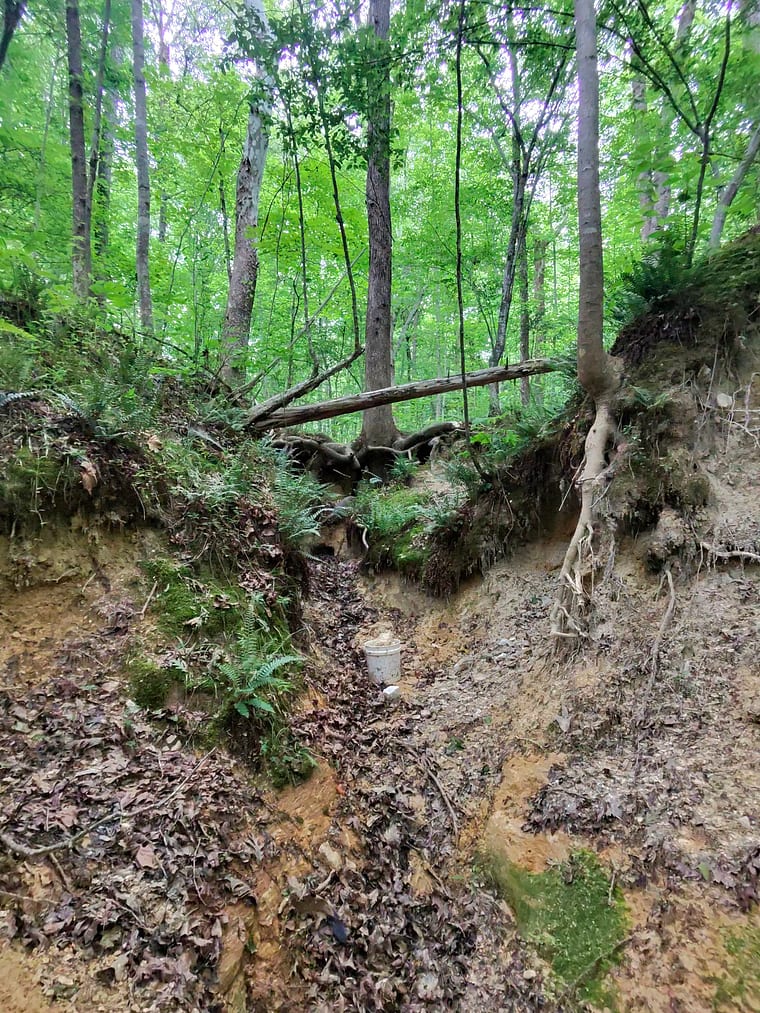
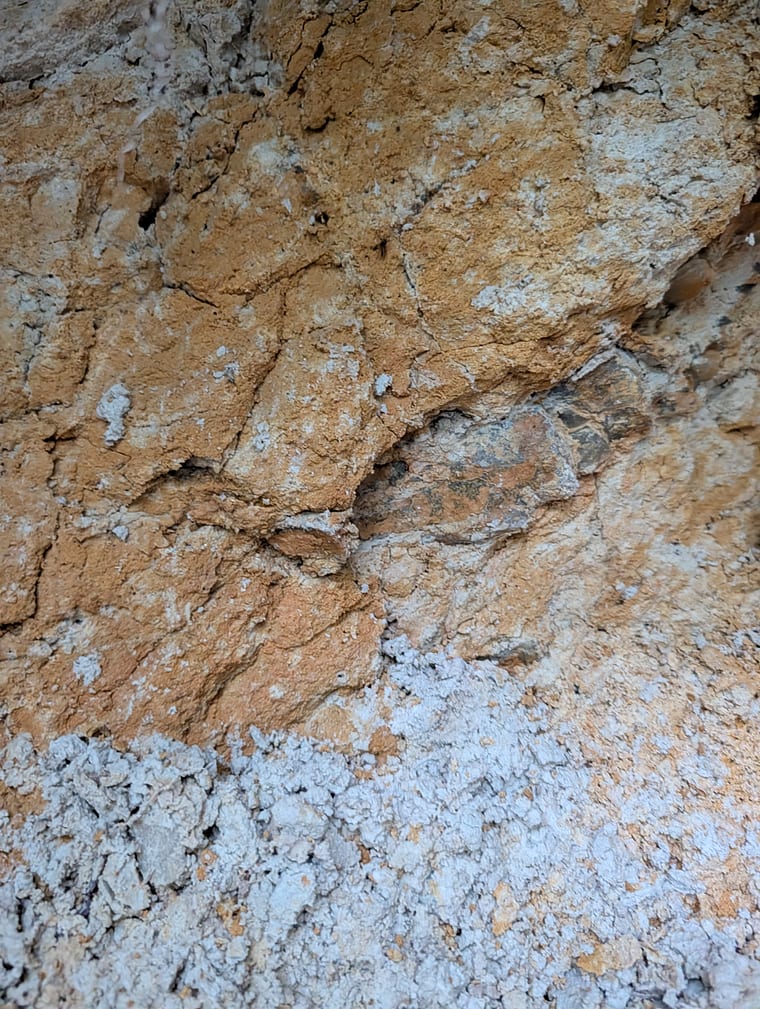
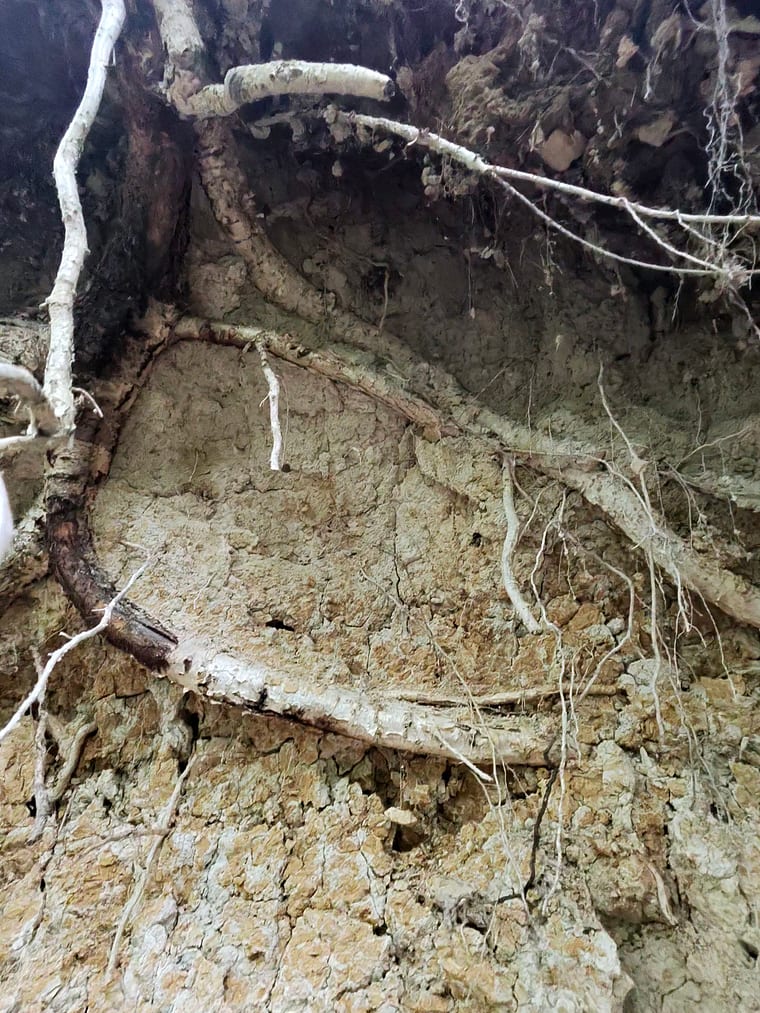
- The root wall of a fallen tree. The white clay I dug came from a gully in the woods where a fallen tree had lifted a wall of pale ground out of the slope.
- Construction sites, fresh post holes, the spoil beside a new drainage ditch.
- Eroded old fields where the plough runs in the subsoil itself: ground that is sticky in January and brick-hard in August, with that same orange or red showing through the stubble.
Look for the colour change. Under the dark top there is a band of a different colour, smoother and denser than what is above it. That band is what the survey calls the clay layer, and it is what you are after.
Step 3: know it by hand
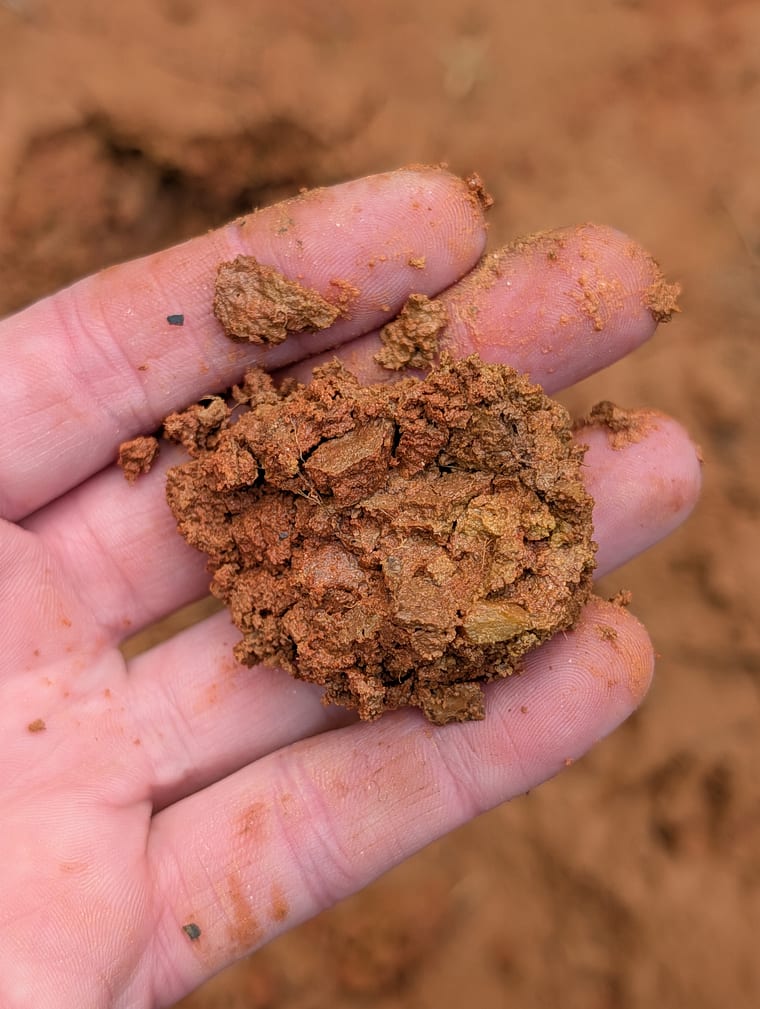
Take a pinch, wet it, and rub it between thumb and finger. Clay feels smooth and slick, not gritty, and smears rather than falling apart. Press a thumb into a damp lump: clay holds the print. Then the test I trust most: roll a coil as thick as a pencil and bend it round your finger. If it bends with few cracks, it is clay worth testing. If it crumbles, there is little clay in it. A wet pinch pushed out between thumb and finger into a ribbon an inch long says the same thing.
Raw colour is not fired colour. Orange and red ground is coloured by iron and usually fires somewhere between terracotta and brown. Grey and white ground often has less iron and can fire pale. A grey band that looks dull in the bank can be the best clay on the hill, so do not pass it over for the pretty red one.
Step 4: take a little, test it, then dig more
A fist-sized lump to a bucketful is enough for a first test. Dry it fully. Break it up (I grind mine to a powder; a hammer on a lump in a bag does the job), then slake it in water until it falls apart, stir, and pour it through a kitchen sieve or a piece of window screen to take out the roots and grit. Let it settle, pour off the clear water, and dry the slurry on a plaster slab, a board or a cloth until it is stiff enough to work.
Make a test bar and a small pinch pot. Scratch a line of known length on the bar and measure it again after drying and after firing: that is your shrinkage. Fire the pieces with your usual load. Did the bar crack, bloat, slump or hold its shape? Is the pot sound? Now you know what you have, and only now is it worth going back with a bigger bucket.
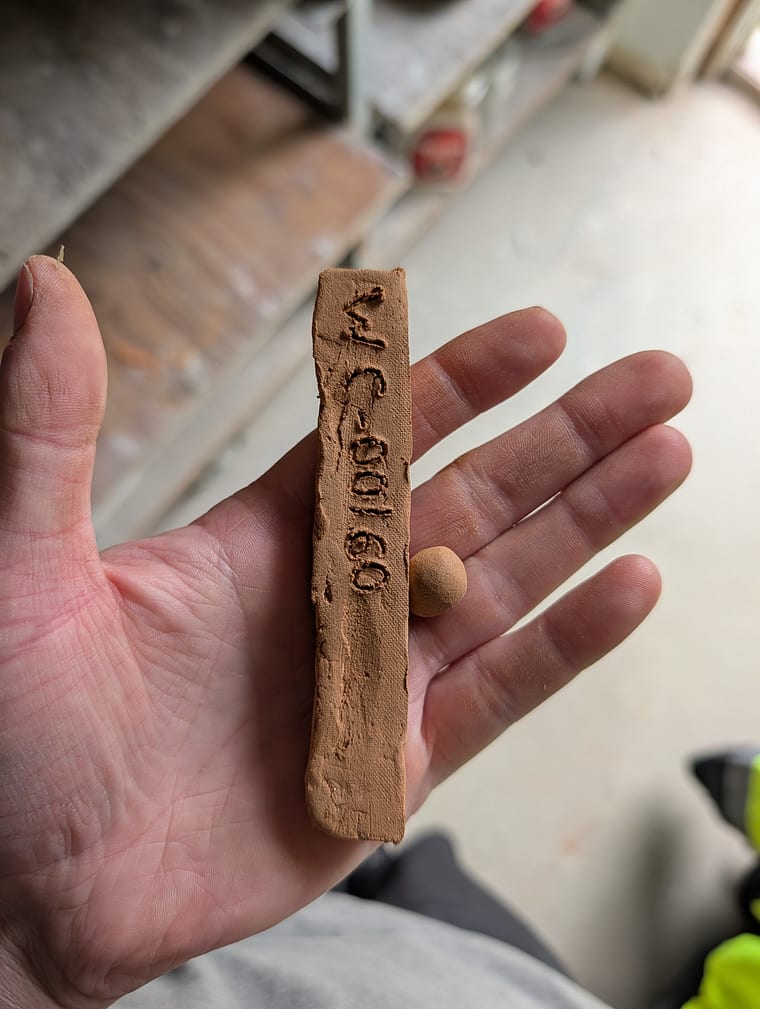
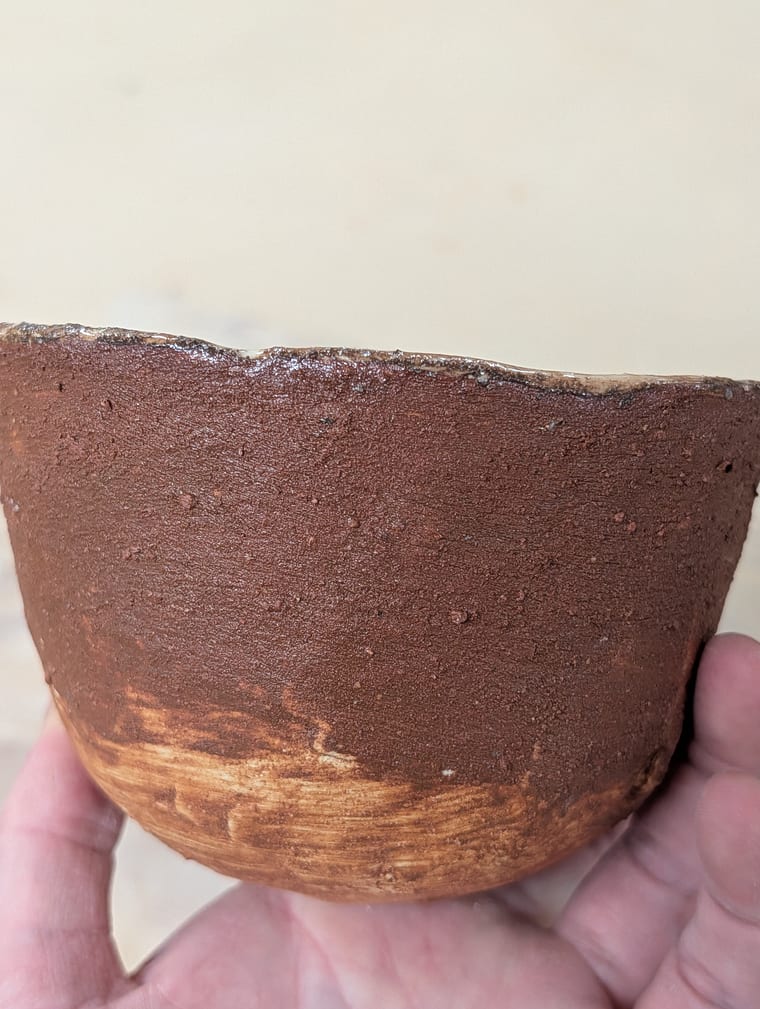
Step 5: permission, and leave it as you found it
Someone owns every piece of ground. On private land, ask; most people will say yes to a bucket when you tell them why. Road right of way, parks, national forests and state land each have their own rules and many forbid digging, so check before you collect. Fill your hole, keep off the stream bed itself unless you know the rules, and watch for ticks and poison ivy in the kind of gully where clay shows.
Soil information does not grant access or permission to dig. Verify ownership, local rules, and permission before visiting or collecting.
Short answers
How deep is clay?
In a typical profile the clay layer starts about a foot down and runs to three or four feet, but it varies by soil. The map gives the typical depth for the soil mapped at your spot.
What colour is wild clay?
Any colour. Red, orange, brown, grey, white, nearly black. Colour comes from iron and organic matter, and the raw colour is a poor guide to the fired colour, so test rather than judge by eye.
Is there clay in my backyard?
Very likely there is a clay-rich layer under it. Whether it is worth digging is what the level says: tap your address on the map and read the layer by layer.
Can I use clay from a creek bank?
A creek bank is often the best place to see the layer and to take a sample. Treat it the same way: coil test, dry, slake, screen, fire a test piece. And check who owns the bank and what the rules are before you dig into it.
Start here
Or read the rated soils by state first. The map and the lookups are free; the method on this page costs a bucket and an afternoon.